Brenland Military
The Brenish Armed Forces are the unified military forces of Brenland, reorganized following the Second Crownbreaker War and the ratification of the Writ of Binding Powers, which placed all military authority under the oversight of the Realm Assembly and its Inner Council. The armed forces are divided into two primary branches: the Royal Navy of Brenland (senior service) and the Brenish Territorial Army.
The restructuring marked a decisive shift away from royal-controlled expeditionary warfare toward defensive readiness, maritime security, and internal stability.
Doctrine and Organization
Post-reform military doctrine emphasizes:
- Maritime supremacy and trade protection
- Territorial defense over foreign conquest
- Civil oversight of military command
- Rapid mobilization through trained reserves and conscript levies
The office of the Crownlord serves as the nominal commander of the armed forces, though all declarations of war and major deployments require approval from the Realm Assembly.--
Royal Navy of Brenland
The Royal Navy is the senior branch and primary instrument of national defense. Following the loss of continental holdings, Brenland invested heavily in naval expansion, convoy protection, and coastal surveillance.
Responsibilities
- Protection of merchant shipping and trade routes
- Defense of coastal waters and ports
- Anti-piracy and anti-smuggling operations
- Strategic deterrence against Valseurian and Sanctorian fleets
Naval Infrastructure
Major naval yards and command ports include:
- Rivulon Naval Yard – Headquarters of the Navy and seat of the Admiralty
- Harrowport Dockyards – Primary shipbuilding and repair center
- Northcote Anchorage – Northern fleet base and patrol command
- Craymere Yard – Southern logistics and resupply hub
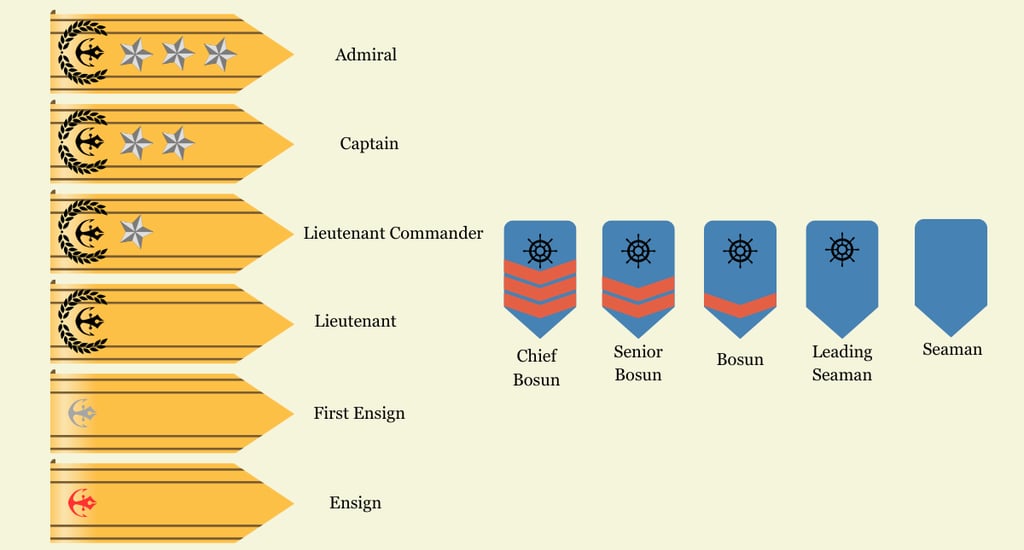
Naval Officer Ranks and Naval Ratings (Enlisted)
Brenish Territorial Army
The Brenish Territorial Army serves as a defensive land force, structured to protect the homeland rather than project power abroad. It is composed of professional soldiers supported by regional levies and militia forces raised through Ealdormen and Barons.
Responsibilities
- Defense of inland territories and infrastructure
- Support to civil authorities during unrest or disaster
- Reinforcement of coastal positions during invasion threats
- Maintenance of fortified posts and strategic roads
Army Garrisons and Posts
- Grayhold Garrison – Primary inland stronghold and training center
- Stratby Command Post – Southern defensive hub near Rynndale
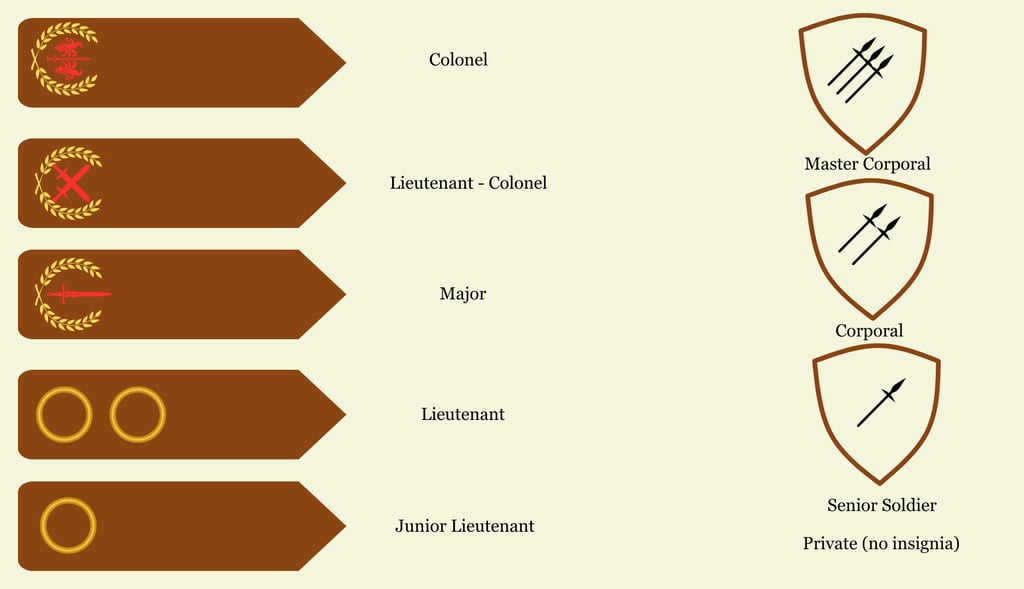
Army Officer and Enlisted Ranks
Command and Oversight
Military governance is administered through the Inner Council, typically via a designated War Steward or equivalent office. This ensures that no single individual—Crownlord included—can command the military without institutional accountability.
Naval and army leadership maintain separate command structures but coordinate through joint councils during crises.
Legacy of Reform
The modern Brenish Armed Forces are shaped by the memory of:
- The naval disasters during the continental withdrawal
- The civil wars against absolutism
- The need to prevent centralized military control under a single ruler
As a result, Brenland’s military culture emphasizes discipline, restraint, and duty to the realm rather than to a sovereign individual.