Holy Covenant Church
Deity
The Creator is eternal, indivisible, and utterly transcendent. He created all and is omnipotence, omniscience, omnibenevolence, omnipresence and omnificence.
Overview
The Holy Covenant Church was developed and established after the Brenish were expelled from continental Ametria by Sanctorian Stellarium forces. The Church thinks of itself the "one true church" due to its rejection of all holy texts and only relies upon the Book of Fundamentals that was established by Avaron when he came to Ametria
Church Doctrine
The Church teaches:
The Creator is the supreme God, sovereign over all creation.
Avaron is the one true prophet of the Creator.
Salvation comes through repentance, faith, and grace, evidenced by good works and loyalty to the Creator as written in the one true holy text, the Book of Fundamentals.
Holy Texts
The Book of Fundamentals
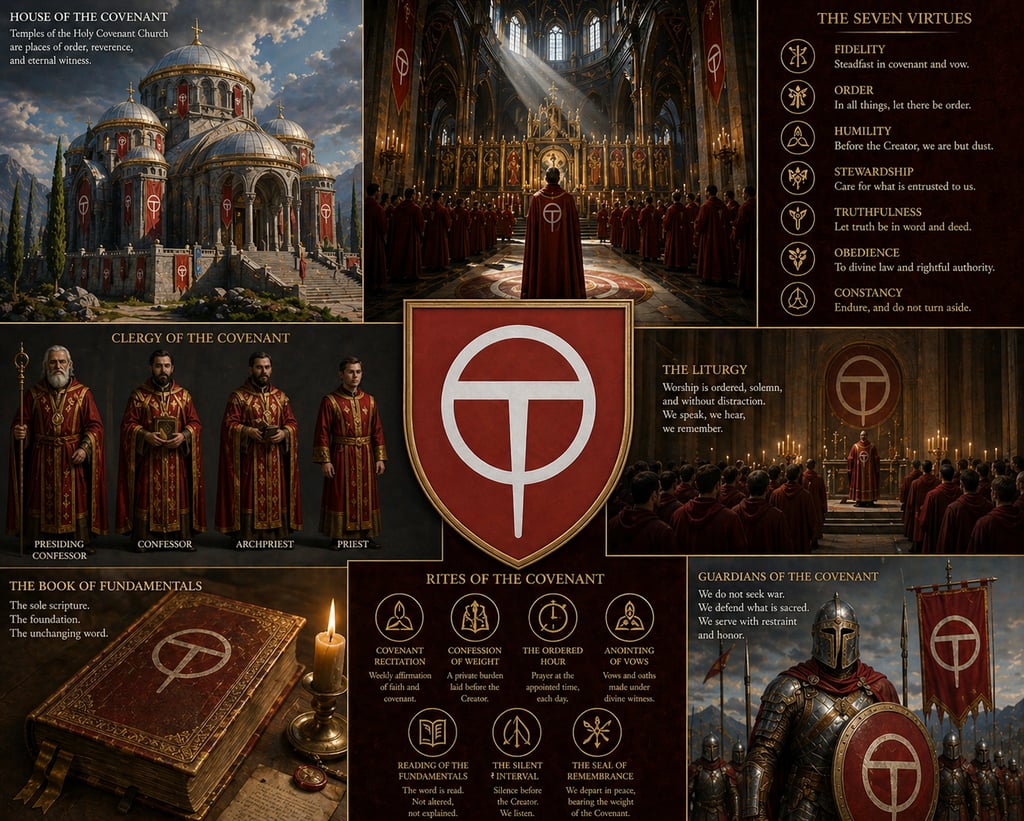
Contains the Covenants, laws, moral codes, and foundational revelations given by the Creator to Avaron and the early faith leaders.
Details early Creation of Ebonyr, humans, animals and the cosmos.
Structured as a mix of parables, legal codes, and theological commentary.
Excerpt from The Book of Fundamentals
The Words Given to Avaron
And the Creator spoke unto Avaron, not in thunder nor flame, but in the still weight of knowing, and said:
“I am before all measures and after all reckonings. I set the bounds of stone and sea, and none may move them without My leave.
Walk not as one untethered, for the world is not made for wandering hearts.
Bind thy life to duty, thy words to truth, and thy hands to honest work. I require not spectacle, nor shouting, nor blood sworn in My name. I require order, remembrance, and the keeping of what is entrusted.
Judge not the heavens, for they are not yours to weigh. Judge yourselves, that you may stand unashamed when called.
Let covenant be heavier than desire, and let obedience be chosen, not forced.
Thus shall your days be set firm, and thus shall your people endure.”
The Seven Virtues of the Covenant
The Holy Covenant Church recognizes Seven Virtues, understood as obligations rather than aspirations. They are taught as disciplines necessary for communal survival and divine favor.
Fidelity
Steadfast adherence to the Covenant, one’s vows, and rightful authority.
Order
Acceptance of structure in worship, society, and the self; chaos is seen as spiritual failure, not freedom.
Humility
Recognition of mortal limits before the Creator; rejection of self-exaltation and false revelation.
Stewardship
Responsible care of land, labor, family, and knowledge entrusted to mankind.
Truthfulness
Speaking and acting without deceit; truth is considered covenantal, not personal.
Obedience
Willing submission to divine law and lawful authority, without coercion or fear.
Constancy
Endurance in belief and practice across hardship, doubt, and generational change.
Symbol
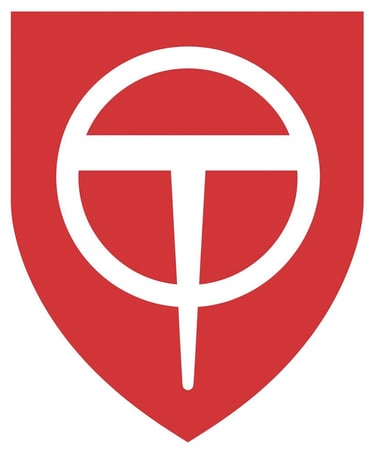
Symbol on the sails of Avaron's ships. Thought to be original symbol of the Creator. Recast as the Symbol of the Holy Covenant Church.
Followers: Covenanters
History
During the height of the Sanctorian ascendancy, Brenland controlled and maintained a large province in the southwest region on the Ametrian continent. These territories became flashpoints after the Sanctorian Church, with its military arm the Stellarium, sought to consolidate religious and political control.
The Brenish–Sanctorian Wars culminated in disaster for Brenland. Stellarium shot and pike formations, backed by Valseurian allies, overwhelmed Brenish defenses. The Stellarium seized the region and proclaimed it the Sanctorian Protectorate, forcing Brenish armies and thousands of civilians to evacuate across the Trade Sea to their island homeland.
The collapse of continental power deeply shaped Brenish identity. Most Brenish were Sanctorian and felt deeply betrayed. This confusion turned into anger which eventually brought down the king. The people then turned their sight on the Brenish Sanctorian Church. Most, if not all, Sanctorian Sanctums were destroyed and the clergy either killed or banished from Brenland. Many Brenish, disillusioned, reverted back to folk druidic religions. Still, a majority of Brenish wanted to continue worshipping the Creator without Sanctorian dress.
Bernard Malvin, an excommunicated Sanctorian Docent, started preaching a "new" version of Creator's message. He said the message of the Sanctorian Church had been corrupted and the original Book of Fundamentals written by Avaron was the only holy text. He rejected the consolidated and centralized power of the Sanctorians. He preached that every urban area should have an independent church. He style himself a "Confessor" in this reformed faith. Unlike the Sanctorian rite, Malvin preached humility and forgiveness as well as rejecting ritual penance for ones sins.
Soon the people flocked to his sermons, sensing a calmness in a raging storm that Brenland had been since the lost of continental Ametria. Malvin established a religious school to teach the new, yet old, faith of Covenant. He planted many churches throughout northern Brenland.
Soon, major churches were planted in Rivulon, Stratby and Tarnleigh. To maintain good doctrine, the church united into Holy Covenant Church. However, each church is independent.
Governance
Presiding Confessor of Rivulon: presiding over the Holy Council., teacher, first elder.
Confessors: Oversee one of the currently four Juris of the church Church.
Cantor: Lead individual churches within the Juris. Conducts main services, etc.
Frater: Conduct provincial ministry and charitable duties.
Holders: lay men that are of good standing in the community. Sound doctrine and zeal for the faith.
Worship & Rituals
Worship blends liturgy and scripture emphasizing confession, scripture reading, hymns, and communal prayer.
Liturgies are formal, chant-based, and highly ritualized
Confession is central but private and pastoral, not juridical
Emphasis is placed on humility, obedience to divine law, and communal stability
Visual worship favors abstraction and symbol over figural representation
Liturgy and Worship Practices
Liturgy within the Holy Covenant Church is formal, restrained, and deliberately uniform across Juris, reflecting the belief that correctness outweighs innovation.
Core Practices
Covenant Recitation
A communal spoken affirmation drawn directly from the Book of Fundamentals, recited weekly and unchanged across generations.
Confession of Weight
A private rite in which the faithful acknowledge personal failings as burdens carried against the Covenant, guided by a Priest or Confessor.
The Ordered Hour
Daily prayer observed at a fixed time determined by the Juris, emphasizing discipline over spontaneity.
Anointing of Vows
A non-sacramental rite marking marriages, oaths of office, and guild obligations, invoking the Creator as witness rather than guarantor.
Reading of the Fundamentals
Public reading without commentary; interpretation is reserved for instruction outside liturgy to prevent doctrinal drift.
The Silent Interval
A mandated period of silence during services, symbolizing submission before divine authority without petition or demand.
The Seal of Remembrance
A concluding gesture—often a bowed head and closed hands—signifying acceptance of the Covenant’s weight upon one’s life.
Marriage Covenant
A binding union of man and woman, sanctified by the Church.
In Brenland, marriages are also seen as symbols of loyalty to the Creator and the survival of the people.
Healing of the Wounded
A sacrament for the sick and injured, especially soldiers.
The priest anoints with oil and lays hands, praying for restoration of body and spirit.
Deeply connected to Brenish military traditions and remembrance of past wars.
Ecclesiastical Structure
The Holy Covenant Church is fully congregational and autocephalous in nature.
Juris System
Each Juris (Church-territory) governs itself independently.
No Juris is doctrinally subordinate to another.
Councils between Juris exist only for mutual consultation, not authority.
Holy Festivals & Holidays
Day of Departure
Marks the evacuation from the Ametrian continent after defeat by the Stellarium.
Observed with fasting during the day, and a solemn evening service remembering loss, exile, and endurance.
Scripture readings focus on faith during hardship and the Creator’s providence in times of exile.
Foundation Day
Honors the establishment of the Holy Covenant Church.
Marked by the reading of the Charter of Faith, in which the clergy declared their break from Sanctorian authority.
Known for grand sermons in cathedrals affirming the bond between the Creator and his followers.
Pilgrims’ Day
Honors the ordinary Brenish families who endured exile and rebuilt their faith at home.
Relationship with Other Faiths
Sanctorian Church: Theologically aligned on the nature of the Creator but rejected for its centralized authority, militancy, doctrinal expansions outside the Book of Fundamentals.
Daisonite Traditions: Rejected entirely as false teachings