Sanctorian Church
History
The Arrival of Avaron and the Charis
In the earliest days of Ametria, before nations were forged, the land was divided among many small city-states, each ruled by its own king. These petty realms clung to old traditions of ancestor and nature worship, revering pantheons of spirits and gods. Into this fractured land came Avaron, a man chosen by the Creator. Guided by divine command, he departed from his home in Cha-ar and sailed westward across the seas with more than two thousand followers, the Charis.
They arrived at the mouth of the Savon River and pushed inland, establishing their first settlement near a great ford. It was there that Avaron built a sanctuary to the Creator, the first such shrine in Ametria, marking the birth of a new and singular faith. Though foreign, the Charis were not perceived as enemies by the neighboring city-kings. Instead, they were seen as potential allies in the endless struggles that consumed the land.
The Charis prospered swiftly. They brought with them wonders unknown in Ametria: black powder firearms such as matchlocks and bombards, a disciplined military with officers, demi-officers, and paid soldiers, and engineering techniques that transformed the land with roads, bridges, and fortifications. They practiced advanced irrigation and metallurgy, and above all, they held unshakable faith in the one true God, the Creator. Through trade, war, and teaching, they spread their ways across the continent.
Over time, their influence reshaped Ametria. The scattered city-states began to coalesce into larger polities, sowing the seeds of the nations that endure to this day. Their faith likewise grew, transforming from a tightly knit ethnocentric creed into a continent-spanning religion.
In time, this faith hardened into the Sanctorian Church, a hierarchical institution and the faith slowly changed from a faith-only salvation to work and penance-based with a strict governance.
As the Creator faith evolved into the Sanctorian Church, clergy interpreted the Book of Fundamentals into a broader framework with the Book of Deeds and Canons and Creeds. The Book of Fundamentals is now seen as a relic of the past and a “new foundation” has been put in place to advance the Creator message. The faith slowly changed from a faith-only salvation to work and penance-based faith with a strict governance and hierarchy.
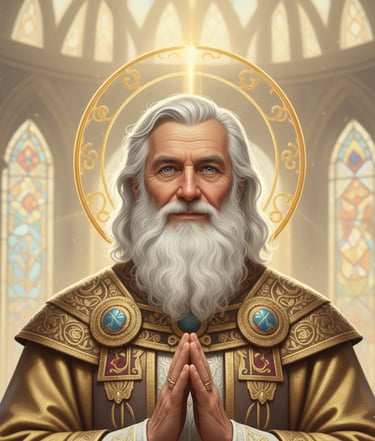
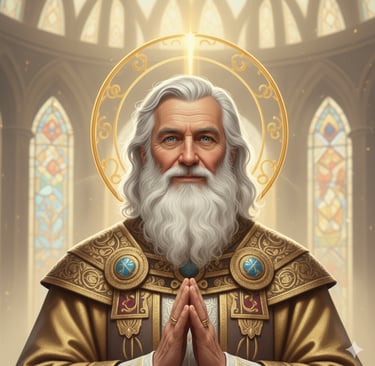
Avaron
Deity
The Creator is eternal, indivisible, and utterly transcendent. He created all and is omnipotence, omniscience, omnibenevolence, omnipresence and omnificence.
Theology
The Creator is eternal, indivisible, and utterly transcendent.
Salvation is earned through righteous conduct, ritual purity, and fidelity to Church teachings and its clergy.
Sanctors and Prelates are honored as models of obedience and sacrifice but are not intercessors.
Law of Penance: Sin must be confessed and absolved through acts of contrition, almsgiving, or service.
Law of Order: Obedience to rulers is obedience to the Creator, unless rulers themselves reject His laws.
The Eight Virtues
"As the stars hold their places in heaven, so must the faithful hold their virtues in order.”
— The Book of Deeds, Chapter II
Obedience
“The star does not question its orbit.”
Absolute submission to the will of the Creator, the Sanctor, and the order of the Church.
Disobedience is seen not merely as rebellion, but as cosmic discord.
Discipline
“He who commands himself commands his surroundings.”
A life ruled by control of body, tongue, and thought. Discipline is the foundation of faith and the weapon of purity.
Devotion
“To pray without ceasing is to breathe in truth.”
Unbroken faith and daily reverence toward the Creator. Devotion is maintained through prayer, labor, and service to the Church.
Illumination
"To see clearly is to serve purely"
The pursuit of divine understanding and wisdom. Scholars and clergy seek to reflect the Creators light through learning and revelation.
Penance
“The proud are the dimmest stars.”
Recognition of one’s failings before the Creator and the willingness to endure correction. Penance purifies the soul through suffering and labor.
Justice
“Truth without mercy is tyranny; mercy without truth is ruin.”
To judge rightly and fairly, according to divine law. Justice preserves harmony between the faithful and maintains the order of the Church.
Fidelity
“The covenant endures in those who endure.”
Faithfulness to oaths, to kin, and to one’s divine calling. Fidelity binds the believer to the Creators grand design and to the Church’s unity.
Zeal
“The cold heart knows no light.”
Holy fervor in service, teaching, and battle. Zeal transforms obedience into action — the fire by which the Stellarium burns for heaven’s cause.
Governance and Hierarchy
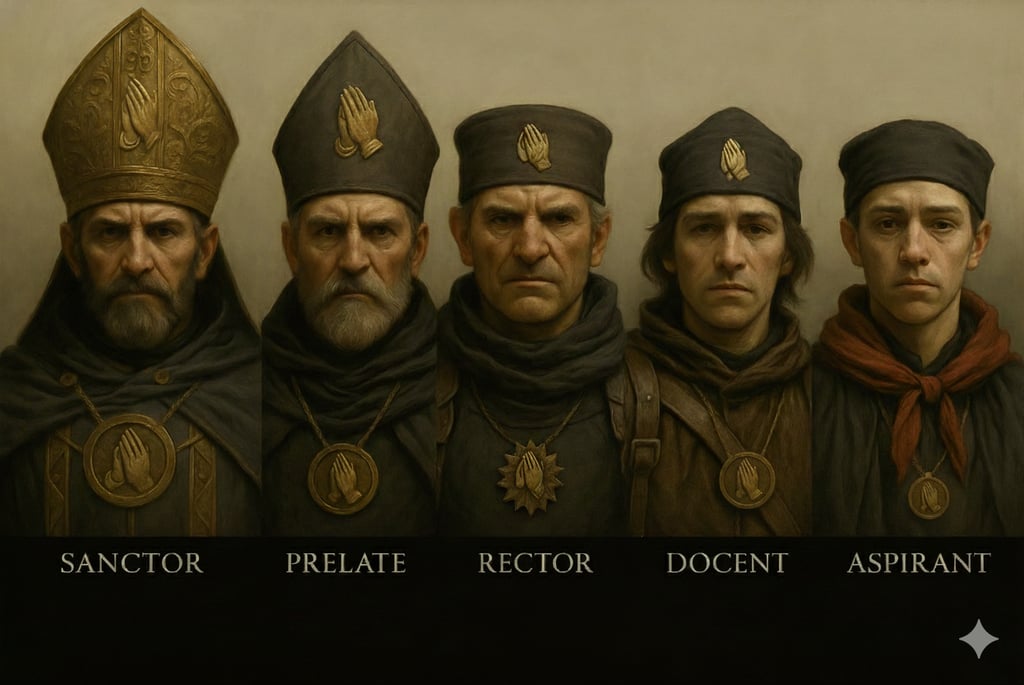
The Sanctor
Supreme spiritual leader of the entire Church, seated Sanctuary (co-located with Honore)
Seen as the Guardian of the Covenant and Interpreter of Divine Order.
Elected by the College of Prelates, but regarded as chosen through providence.
Wears a sigil-ring said to be cast worn by Avaron and blessed by the Creator.
Prelates
Serve as regional patriarchs, overseeing vast ecclesiastical provinces.
Sit on the Synod of Prelates, which advises the Sanctor and adjudicates matters of doctrine.
Often based in major Sanctum-cities
Directly supervise Rectors and ensure proper observance of rites and teachings.
Often serve as judges in doctrinal disputes.
Rector
Head of a local temple; spiritual authority over a city district or rural sanctum.
Leads weekly Observances of the Sanctum and major seasonal rites.
Maintains discipline among Docents and oversees training of Aspirants.
Docent
Veteran clergy responsible for teaching, scholarship, and training within a Sanctum.
Often handle doctrinal instruction, liturgical music, and philosophical debate.
May lead rituals in the Rector’s absence.
Aspirant
Entry-level religious student, undergoing religious education and proving worth.
Lives communally under rectoral guidance, often taking vows of silence, fasting, or celibacy.
May take between 5-7 years before ordination as a Docent.
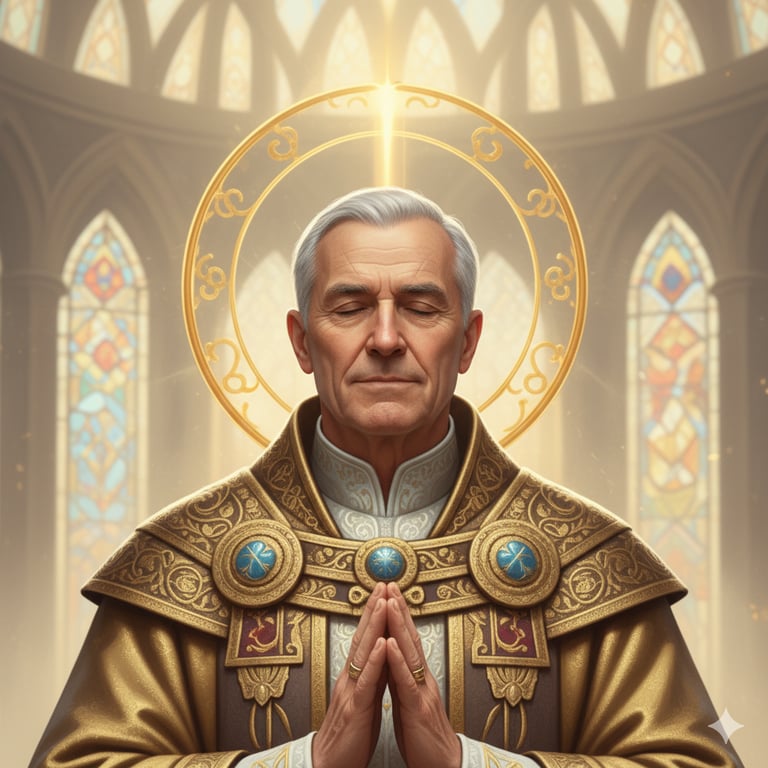
Sanctor Tzamer III
Ritual and Worship
Weekly Observances of the Sanctum include scripture readings, choral chant, incense, and ritual recitations.
Holy Seasons follow a liturgical calendar tied to Church themes.
Pilgrimage to Sanctuary City, is encouraged at least once in a lifetime.
Public Confession and Penance Purification rites are central to personal spiritual maintenance.
Works Acknowledgement - once a month, works of a public and private nature for the Church must be provided.
Holy Texts
The Book of Deeds
Chronicles the actions of historical figures — Sanctors, Prelates, etc. — who upheld and advanced the Churches teachings.
Contains approved epistles, battle chronicles, and hagiographies of early Sanctors.
Often used for moral exemplars, political precedent, and spiritual inspiration.
Emphasis on obedience, duty, ritual precision, and moral clarity.
Used heavily in instruction, legal rulings, and sermons.
The Book of Canons and Creeds
Contains over 100 sections revealing the organization, theology, and governance of the Sanctorian Church.
Includes revelations about priesthood authority, temple ordinances and missionary work.
Documents the Stellarium organization and mission to protect the Church and its teachings
Other divine instructions and doctrinal declarations as given to Sanctors, Prelates and other leaders in the Church
The Book of Fundamentals (incorporating the Scrolls of Avaron)
NOTE: This book is now been supplanted by the Book of Deeds and Canon and Creeds within the Church. The Church leadership has viewed the texts as a “new foundation” of faith in the Creator.
Militant Arm
The Stellarium is the militant arm of the Sanctorian Church, serving as both a standing army and an instrument of ecclesiastical authority across Valseur, Southern Lyncanth, and the Sanctorian Protectorate. The Stellarium emerged as the Church’s primary means of enforcing doctrine, projecting military power, and maintaining control over theological populations.