Cavasson History
I. Tribal Age
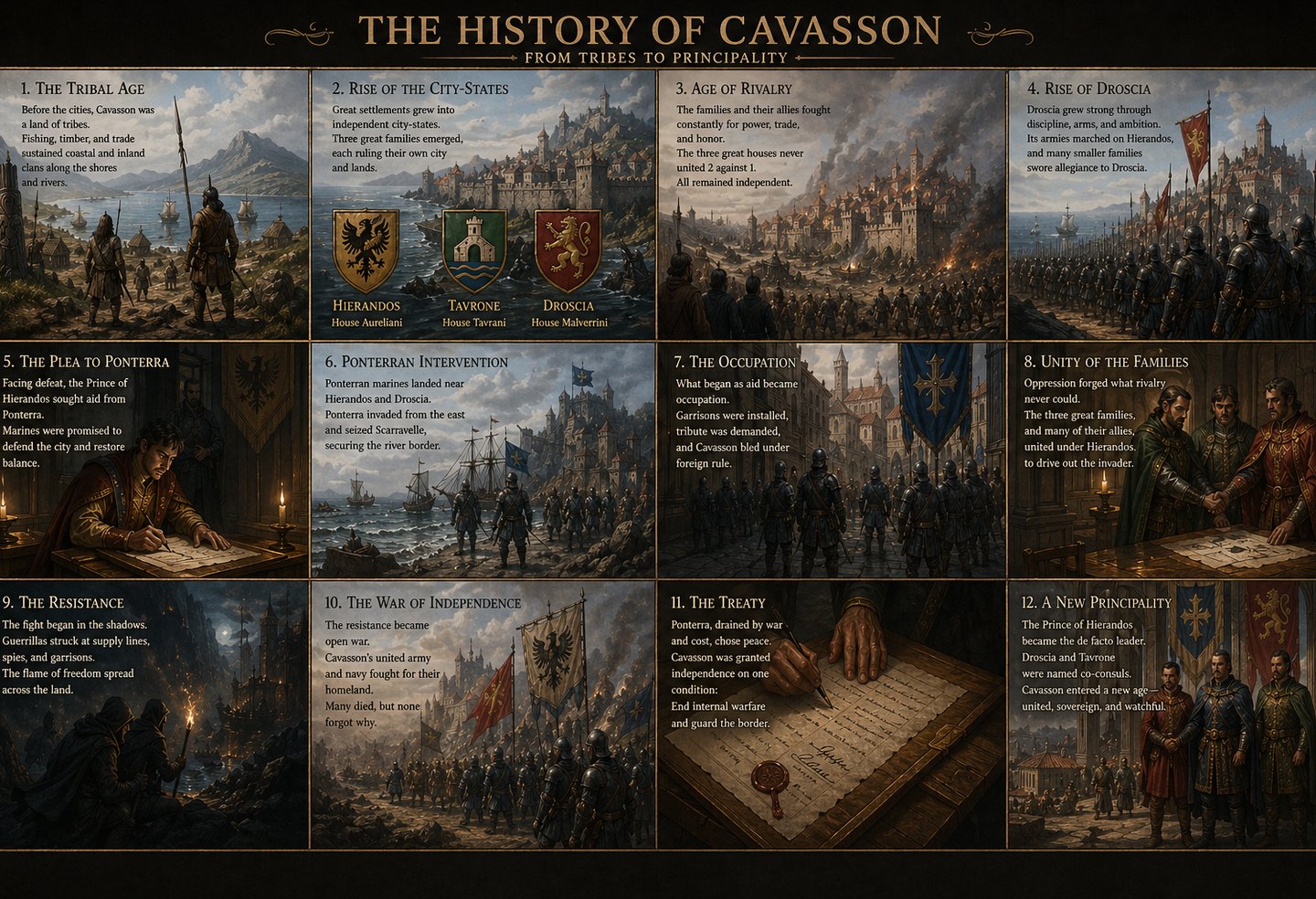
Region composed of coastal and inland tribes
Economy based on fishing, timber, and local trade
Early Cavassi dialects emerge
No centralized authority
II. Rise of the City-States
Key settlements grow into independent cities:
Hierandos (political center)
Tavrone (river and border trade)
Droscia (eastern coastal stronghold)
Emergence of three dominant families, each ruling a city-state
Numerous lesser families align as clients or allies
III. Age of Family Rivalry
Constant intercine warfare between city-states and families
Conflicts driven by:
Trade dominance
Territorial control
Family prestige
Balance of power maintained:
No lasting 2 vs 1 alliances among the three major families
Each house remains independent
IV. Rise of Droscia
Droscia expands militarily, gaining strength and momentum
Campaign begins toward Hierandos
Several lesser families defect from Hierandos to Droscia
Result: Hierandos faces potential defeat and collapse
V. Ponterran Intervention
Prince of Hierandos requests military aid from Ponterra
Initial Actions
Ponterran marines land near:
Hierandos (to “defend”)
Droscia (to “stabilize”)
Simultaneous eastern push:
Ponterra seizes Scarravelle
Establishes foothold along coast and border
VI. Occupation Period
Ponterran forces transition from allies → occupation force
Policies
Tribute demanded for “protection”
Garrisons installed across Cavasson
Families lose autonomy
Effects
Economic strain
Growing resentment across all regions
Realization that Ponterra intends long-term control
VII. The Cavassonian Unity
For the first time:
The three great families unite
Hierandos becomes the center of resistance
Tavrone and Droscia align as co-equal partners
VIII. The Resistance War
Begins as underground guerrilla campaign:
Sabotage
Assassinations
Disruption of supply lines
Escalates into:
Open warfare
Coordinated military resistance
IX. War of Independence
War becomes costly for Ponterra:
High manpower losses
Expensive to maintain supply lines
Cavasson proves difficult to hold
Ponterra wins military victories, yet cannon win the war.
X. The Independence Treaty
Ponterra negotiates withdrawal
Terms: Cavasson granted independence
Conditions:
End of internal family warfare
Enforcement of border stability with Ponterra
XI. Formation of the Principality
New Political Structure
Prince of Hierandos becomes de facto national leader
Droscia and Tavrone recognized as co-consular powers
Families retain influence but operate under unified state framework
XII. Present Legacy
End of constant civil war
Emergence of:
Unified military (Battalia system)
Centralized naval development
Persistent tension remains between:
Former rivals
Regional power bases
Cavasson defined by:
Hard-won unity
Distrust of foreign intervention
Balance between powerful families