Municipal Flag
Wallen
Wallen Districts
Kranenburgh
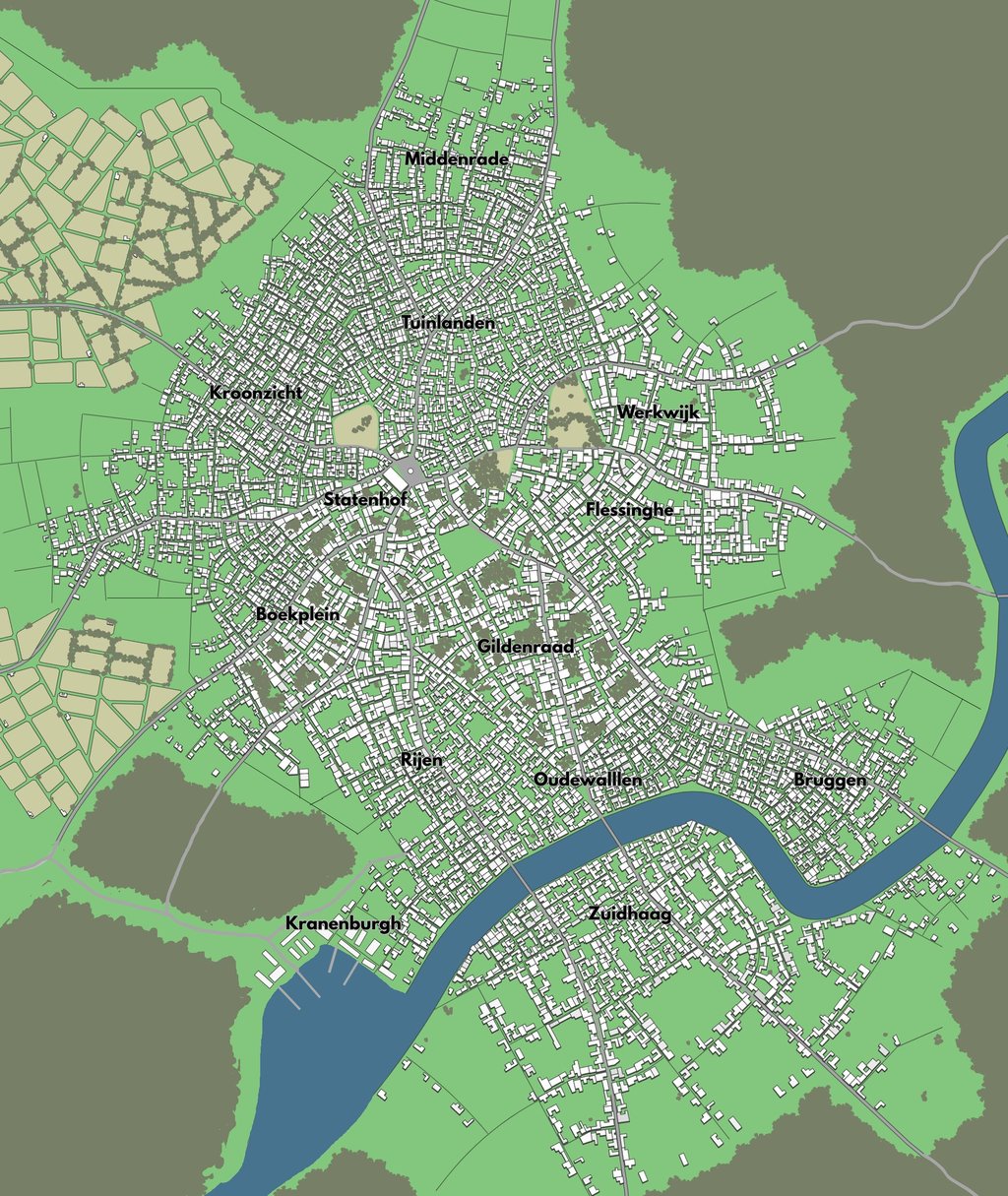
Kranenburgh is Wallen’s old wharf-and-warehouse quarter, occupying the southwestern reaches of the city along the lower banks of the Haag. It is defined by long quays, crane lines, bonded storehouses, counting sheds, cooperies, chandlers, rope stores, and crowded dock inns. Though commercially vital, it is not a prestigious district; most residents are wharf laborers, sailors, tally clerks, lightermen, and carters who serve the ceaseless movement of cargo between river and sea. The district is noisy, damp, and perpetually congested, with broad quay roads near the waterfront giving way to narrower lanes behind the storehouses. Fires, theft, and smuggling are constant concerns, making Kranenburgh one of the most heavily watched commercial districts in the capital.
Zuidhaag
Zuidhaag lies south of the Haag River and forms one of the great working-class expanses of Wallen. It is a dense district of laborers’ rows, tenement courts, corner markets, chapel houses, ale cellars, and small workshops, inhabited by porters, craftsmen, shipyard hands, teamsters, and the families of river workers. Though poorer than the north-bank commercial wards, Zuidhaag is lively and socially durable, with strong neighborhood identity and a thriving street culture of hawkers, bakers, repairmen, and local taverns. Its main roads are built to handle heavy wagon traffic moving toward the docks and bridges, while its interior lanes are more tangled and crowded. The district provides much of the manpower that keeps Wallen functioning.
Bruggen
Bruggen is the southeastern bridgeward of Wallen, a working-class district built around the approaches, markets, and service streets connected to the city’s major eastern crossings. It is a place of ferrymen, bridge toll clerks, cart drivers, fishmongers, hostel keepers, petty traders, and laborers attached to the traffic of the river. Because so much movement passes through Bruggen, it is one of the busiest and most mixed districts in the city, with warehouses and cheap lodging standing beside market courts and common dwellings. The district has a transient character compared to more rooted neighborhoods, and many recent arrivals to Wallen pass through or settle here first. Its proximity to eastern quays and river traffic gives it commercial importance disproportionate to its social standing.
Oudewallen
Oudewallen is the original city on the north side of the Haag, the oldest continuously settled quarter of Wallen and the historical mercantile heart from which the capital expanded. It is a district of artisans, small merchants, inherited shopfronts, guild workshops, old prayer halls, and narrow brick streets whose pattern long predates the city’s planned expansions. Many of Wallen’s oldest families began here before later generations moved into richer districts, and the ward still carries great historical prestige despite its increasing congestion. Goldsmiths, printers, cloth dealers, cabinetmakers, and respected guildmasters are common here, and its markets are among the most established in the city. Architecturally, Oudewallen is marked by tall gabled houses, tightly packed courts, and some of the oldest civic buildings in the capital.
Rijen
Rijen is an upper-class district lying north of Kranenburgh and northwest of Oudewallen. It is known for its broad residential streets, merchant mansions, investment houses, and well-kept private courts, occupied by wealthy traders, senior guild families, successful shipowners, and lesser officeholders who want proximity to the city center without living amidst the crush of the riverfront. Rijen acts as a transition between Wallen’s old commercial core and its more refined northern quarters. The district has fewer warehouses and more formal homes, private gardens, and discreet chapels, giving it a quieter and more orderly atmosphere than neighboring wards. It is considered respectable, established, and comfortably prosperous rather than ostentatious.
Gildenraad
Gildenraad is the district of concentrated institutional wealth in south-central Wallen, where the great guild treasuries, syndicate halls, corporate storehouses, endowed counting houses, and mercantile foundations maintain their seats. Though not wholly residential, it contains some of the most powerful buildings in the city outside Statenhof, and much of Wallen’s commercial influence is exercised here through guild councils, arbitration chambers, and endowed fraternities. The district is less flamboyant than a noble quarter would be in a monarchy; its wealth is expressed through stone halls, archives, private courts, secure vaults, and guarded offices rather than pageantry. Senior guild officers, legal clerks, financial agents, and trusted retainers dominate the resident population. Gildenraad represents the disciplined wealth of Sherran at its most organized and institutional.
Boekplein
Boekplein is a west-central district associated with literate service, upper-class respectability, and the professional strata of the Sherrani state. It is home to many government workers, archivists, legal assistants, educated clerks, tutors, publishers, surveyors, and minor administrators who serve the machinery of the Commonwealth. Though not as politically important as Statenhof, it is deeply connected to it, with many residents employed in ministries, records offices, or state-supported scholarly institutions. The district is characterized by neat housing rows, quiet squares, bookstalls, copy houses, and reputable boarding residences. Boekplein is regarded as sober, learned, and respectable, a district where education and officeholding matter more than inherited trade wealth.
Statenhof
Statenhof is the governmental core of Wallen and the formal heart of the Commonwealth of Sherran. Located centrally, it contains the principal halls of the Estates, major administrative courts, treasury offices, archives, guarded records houses, and ceremonial plazas used for proclamations, receptions, and public observances. The district is more planned and spacious than the surrounding city, with broad avenues, controlled access points, and large public buildings designed to reflect order, confidence, and civic permanence. Though relatively few people live within its immediate core, it is crowded daily by officials, petitioners, scribes, guards, messengers, and delegations from across the Commonwealth. Statenhof is less a neighborhood in the domestic sense than a seat of state power.
Kroonzicht
Kroonzicht is an upper-class district in the northwest of Wallen, favored by old mercantile dynasties, estate families, senior magistrates, and prominent financiers. It is one of the city’s most desirable residential wards, known for broad streets, elegant brick residences, enclosed gardens, formal houses of assembly, and a distinctly reserved social atmosphere. Compared to Rijen, Kroonzicht is older in prestige and more elevated in reputation, serving as the preferred address of the capital’s most secure and politically connected households. Its residents are closely linked to both the state and the highest reaches of commerce. The district’s architecture is restrained but imposing, reflecting Sherran’s tendency toward wealth without aristocratic flamboyance.
Tuinlanden
Tuinlanden occupies the north-central area of Wallen and serves as a broad middle-class district of orderly streets, garden plots, parish courts, and small local markets. It is home to schoolmasters, ship officers, merchants of modest means, clerks, physicians, master craftsmen, and prosperous householders who prefer distance from the docks and industrial wards. The district developed as Wallen expanded northward, and its more regular street plan reflects later growth rather than medieval inheritance. Tuinlanden is seen as practical, respectable, and family-oriented, with cleaner air and more space than the crowded river districts. It is one of the most stable residential wards in the capital.
Flessinghe
Flessinghe is an east-central district of colleges, lecture halls, endowed residences, and upper-class domestic streets, making it one of Wallen’s most refined and learned quarters. It is home to scholars, professors, wealthy patrons, advanced students, high-ranking tutors, and the families of educated officials. Its institutions give it intellectual prestige, while its upper-class housing ensures it remains socially exclusive. The district’s streets are lined with formal halls, gardens, printers’ shops, private chapels, and residences funded by mercantile benefactors. Flessinghe plays a major role in forming the Commonwealth’s educated elite and is regarded as one of the capital’s most cultivated districts.
Werkwijk
Werkwijk is Wallen’s principal industrial district, lying just north of Flessinghe and forming a sharp contrast with that ward’s scholarly quiet. It is a hard-working quarter of foundries, machine shops, carpenters’ yards, spring-tech manufactories, timber depots, smokehouses, and workers’ courts. Much of the district is occupied by skilled and semi-skilled laborers, mechanics, journeymen, smiths, and industrial teamsters, making it one of the city’s most economically productive but socially rougher wards. The air is marked by smoke, hammering, and the smell of oil, metal, and cut timber. Werkwij is vital to Sherran’s reputation for invention and disciplined manufacture, even if it is not admired for beauty.
Middenrade
Middenrade is the extreme northern suburb of the capital, a broad and mixed district of middle- and working-class households, market roads, workshops, storage yards, and newer residential streets built as Wallen spread beyond its older limits. It functions as both suburb and service district, housing cartmen, warehouse hands, shopkeepers, junior clerks, school families, retired sailors, and migrants who have found more affordable lives at the edge of the metropolis. Compared to the inner city, Middenrade is airier and less congested, though also less prestigious and less tightly policed. It is an important zone of future growth, where the capital is steadily extending into roads, gardens, drainage fields, and new developments.