Military of Ponterra
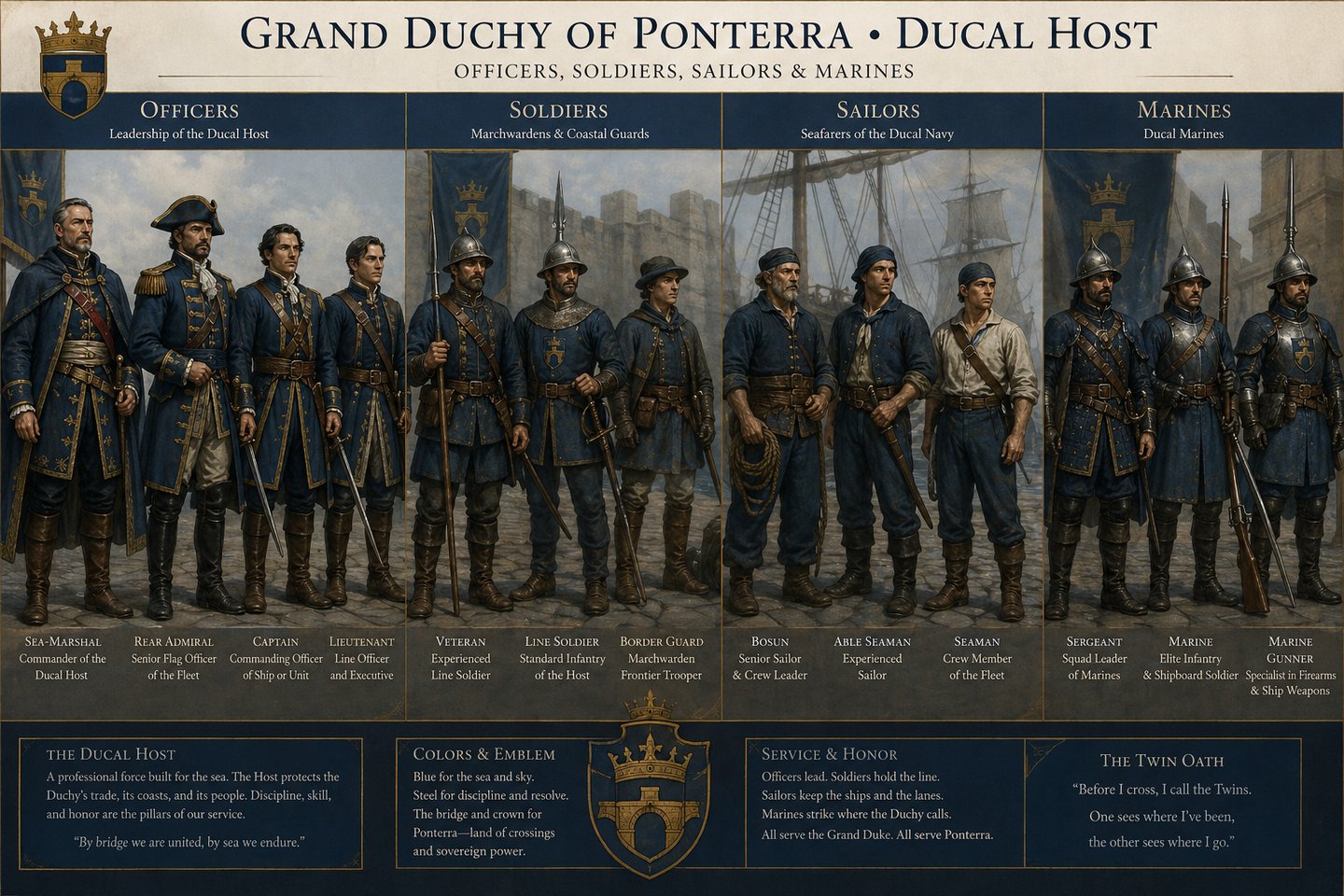
The military of Ponterra, collectively known as the Ducal Host, is a professional maritime-focused force designed to secure trade routes, defend coastal territories, and project limited regional power. Unlike larger continental armies, the Host emphasizes discipline, mobility, and naval integration over massed land warfare.
Command Structure
The Ducal Host is commanded by the Sea-Marshal of Ponterra, the highest military authority beneath the Grand Duke. The Sea-Marshal oversees all branches of the Host and advises the ducal court on matters of war, trade protection, and naval policy.
Below the Sea-Marshal, command is divided into four primary branches:
Admiralty of the Fleet – naval command
Marine Command – expeditionary and shipboard infantry
Coastal Command – harbor defense and patrol forces
Marchwardens – border and inland security forces
Each branch operates semi-independently but is unified through centralized logistics and officer training from the Officers Academy in Ponterra City.
Naval Forces
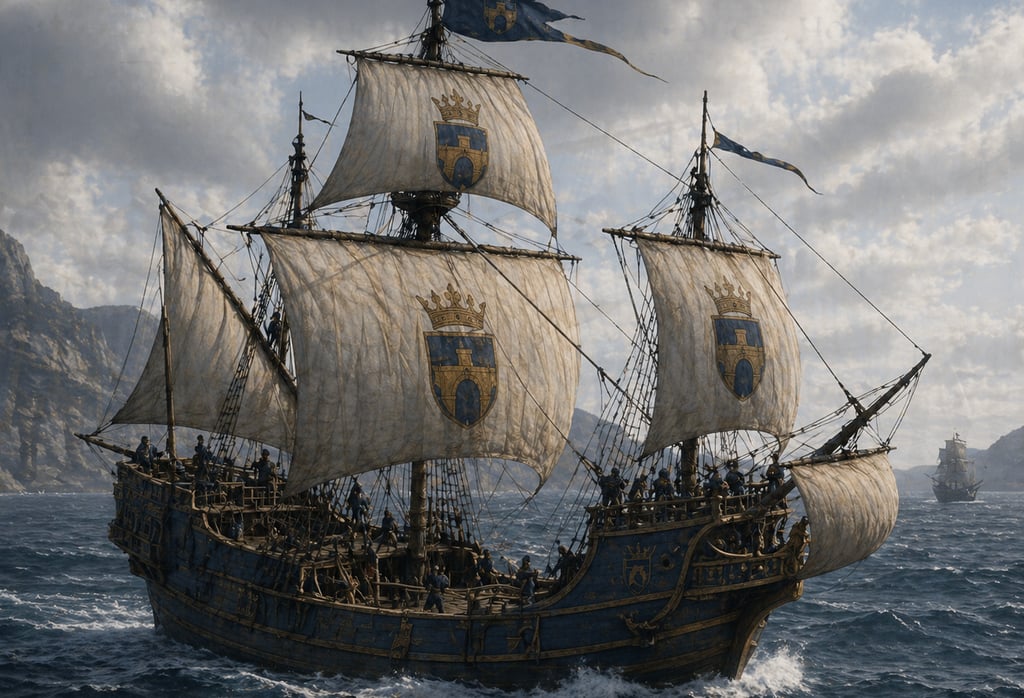
The navy is the core of Ponterra’s military power. Though relatively small compared to major empires, it is highly professional and technologically refined.
The fleet consists of:
Heavy Carracks – command vessels and long-range escorts
Trade Escorts – fast, maneuverable ships designed to protect merchant convoys
Coastal Cutters – shallow-draft vessels used for patrol, interception, and anti-smuggling operations
Harbor Guard Ships – permanently stationed defensive vessels in major ports
Ponterran naval doctrine prioritizes:
Control of key sea lanes
Escorting merchant fleets
Denial of enemy access to harbors
Precision engagements over prolonged fleet battles
Captains are often drawn from both noble families and merchant backgrounds, reflecting the close relationship between commerce and warfare.
Marine Corps
The Ducal Marines serve as both shipboard soldiers and expeditionary infantry. They are trained for:
Boarding actions
Amphibious landings
Port seizures and defense
Urban combat in coastal settlements
Marines are heavily drilled in discipline and coordinated movement, often fighting in tight formations suited to ship decks and narrow streets. They are considered elite within the Host and frequently deployed as rapid-response forces.
Coastal Command
Coastal Command oversees the defense of Ponterra’s extensive shoreline. This includes:
Fortified harbors and watchtowers
Signal stations for communication across the coast
Anti-piracy patrols
Customs enforcement and maritime law
Harbor fortifications in Calmira and Ponterra City are among the most advanced in Ferrencia, featuring layered defenses, elevated artillery platforms, and controlled entry channels.
Marchwardens
The Marchwardens are responsible for inland and border security, particularly along contested regions near Cavasson and other Ferrencian states. While less prestigious than naval service, they are essential for maintaining territorial integrity.
Their duties include:
Border patrols
Suppression of banditry
Protection of trade roads
Support for local magistrates
They operate in smaller, flexible units and are often recruited from rural populations.
Recruitment and Training
Ponterra maintains a professional standing force, supplemented in wartime by:
Noble marine levies
Guild militias (particularly from shipwrights and dockworkers)
Contract sailors and auxiliary crews
Training is centralized in Calmira, which serves as the military heart of the Duchy. Facilities include:
Naval yards for live training exercises
Marine drill fields
Coastal fortification simulators
The Officers Academy of the Iceforge in Ponterra City produces the officer corps. Instruction focuses on navigation, engineering, command, and maritime law, reflecting the Duchy’s strategic priorities.
Doctrine and Strategy
Ponterran military doctrine is rooted in maritime control and economic protection. The Duchy avoids large-scale land wars unless necessary, instead relying on:
Naval pressure and blockades
Economic disruption of rivals
Rapid marine deployments to key locations
Wars are typically fought to secure trade advantages, protect shipping, or enforce political agreements rather than territorial conquest.
Identity and Tradition
The soldiers of the Ducal Host are seen as guardians of the Duchy’s lifeblood—the sea. Service in the navy or marines carries high prestige, particularly among coastal populations.
Common traditions include:
The Twin Oath – sworn before deployment, invoking both past duty and future outcome
Launching Rites – ships are blessed at threshold temples before first voyage
Salt Marking – marines mark their gear with saltwater before battle as a symbol of origin and fate
Uniforms favor deep blues, weathered leathers, and metal fittings designed for maritime conditions. Officers often wear cloaks bearing the bridge-and-crown sigil, symbolizing Ponterra’s unity of land and sea.