Tartesso Military
Overview
The military of Tartesso is not a traditional standing army but a dual-system force built around internal control and selective power projection. Its structure reflects the priorities of the Electors: stability, surveillance, and protection of wealth over large-scale conquest.
The Dominion relies on:
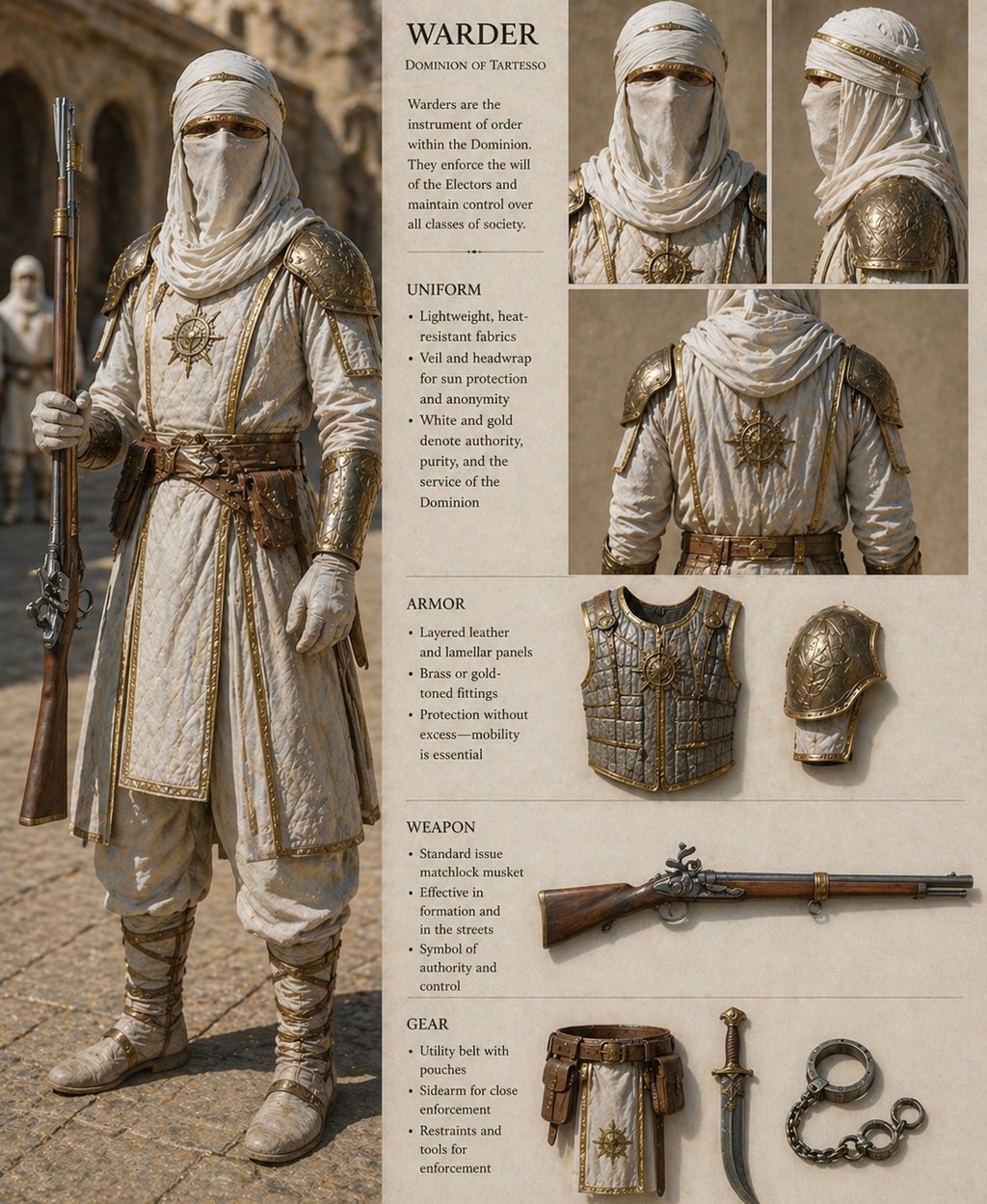
The Warders (primary land and internal force)
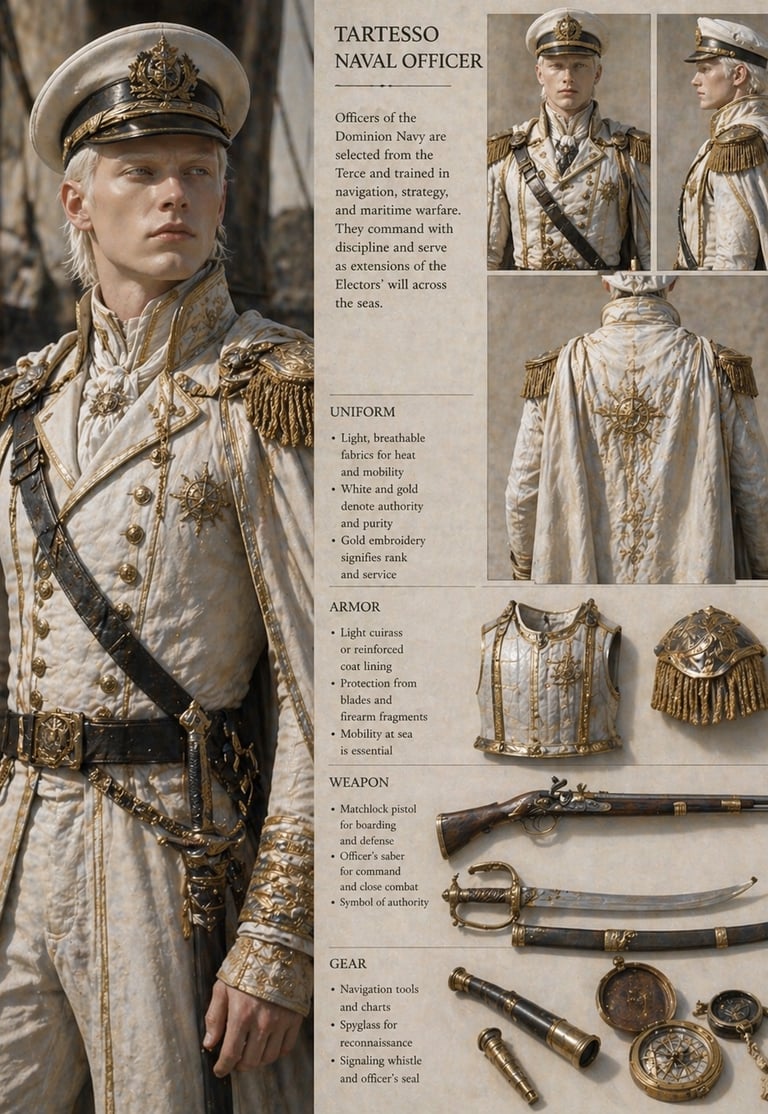
The Dominion Navy (maritime power and external projection)
Command Structure
Ascendent – Supreme authority over all military forces
Elector Council – Strategic oversight; controls funding, deployments, and officer appointments
High Warder-Marshal – Commander of all Warder forces
Grand Admiral of the Dominion – Commander of the Navy
Command authority is deliberately fragmented to prevent any single military figure from threatening the Electors.
Core Components
1. The Warders (Internal Security & Land Force)
Role
Internal policing and surveillance
Suppression of unrest (especially among Dusties)
Enforcement of economic and social laws
Acting as the primary army during wartime
Structure
Urban Warders – Uniformed police and riot control
Veiled Agents – Undercover operatives embedded in guilds, temples, and trade networks
Contract Enforcers – Oversee labor systems, especially Grubber populations
Border Guard Division – Secures the Roughbounds and eastern frontier
Elite Units - Desert Wardens
Long-range patrol units operating in the Shugath Gol Desert
Track smugglers, fugitives, and runaway Grubbers
Highly self-sufficient and feared even among Warders
Characteristics
Highly disciplined but politically controlled
Loyal to the Elector system, not to a national identity
More focused on control than battlefield maneuver warfare
2. The Dominion Navy
Role
Coastal defense and patrol
Trade route protection
Anti-smuggling operations
Limited blue-water power projection
Structure
Three Major Naval Commands (each tied to a major port region)
Naval Infantry Barracks attached to each naval base
Patrol Fleets (coastal enforcement)
Expeditionary Squadrons (blue-water operations)
Operational Reach
Regular presence in: Meridian Sea, Sunsrest Sea, Occasional deployments into the Little Sea
Characteristics
Fast, maneuverable vessels optimized for interception
Emphasis on boarding, seizure, and enforcement rather than fleet battles
Naval Infantry trained for:
Port seizures
Ship boarding
Coastal raids
Doctrine
Tartessian military doctrine is built around three core principles:
1. Control Above All
Military exists to maintain internal order
Suppression of revolt is prioritized over external war
2. Fragmented Strength
Forces are intentionally divided between Warders and Navy
Prevents unified military power that could challenge the Electors
3. Selective Projection
External operations are limited, calculated, and economic in purpose
Focus on:
Trade enforcement
Anti-smuggling
Strategic intimidation
Recruitment and Composition
Warders
Drawn primarily from the Terce-equivalent class (loyal, skilled citizens)
Some Dusties recruited into lower ranks for dangerous roles
Advancement tightly controlled and monitored
Navy
Mix of Terce sailors and specialized naval infantry
Officers often tied to Elector families or patronage networks
Desert Units
Often recruited from frontier peoples or semi-nomadic groups
Given limited privileges in exchange for service
Equipment and Warfare Style
Weapons
Spears, curved blades, and shields for close combat
Muskets or mechanical ranged weapons
Naval crews equipped for boarding combat
Armor
Light, breathable armor suited for heat
Veils and layered cloth for sun protection
Tactics
Urban suppression formations
Ambush and pursuit in desert terrain
Naval interception and boarding actions
Avoidance of large-scale pitched battles unless necessary
Strategic Role in Ametria
Seen as a controlled but dangerous power
Not expansionist, but highly protective of trade and internal order
Capable of sudden, precise intervention—especially at sea
Summary
The Tartesso military is not designed to conquer—it is designed to control, contain, and enforce.
Its strength lies not in massed armies, but in constant surveillance, economic enforcement, and swift, targeted force.